Peeping and the Return Gaze
Rear WindowPeeping and the Return Gaze is the story’s organizing pattern of observation and exposure. From his bay window, Hal Jeffries turns enforced inactivity into a study of neighboring lives, interpreting routines from a distance while remaining unseen. That apparent one-way view changes when Lars Thorwald repeatedly scans the rear windows and finally directs a purposeful glance at Jeffries’s own window. The reversal makes looking both a means of acquiring knowledge and a source of danger: the observer can read others only imperfectly, and can himself become the object of someone else’s attention.
A View Shaped by Confinement
Jeffries’s observations begin under practical limits. His movements are restricted to the short distance between his bed and the window, and he cannot sleep or occupy himself with books. The bay window is therefore a place to spend long hours as well as a vantage point. Because it is unscreened, he sits there with the light out, avoiding insects and keeping his own presence difficult to see. Watching is prompted by idleness, but its conditions also give the activity a secretive quality.
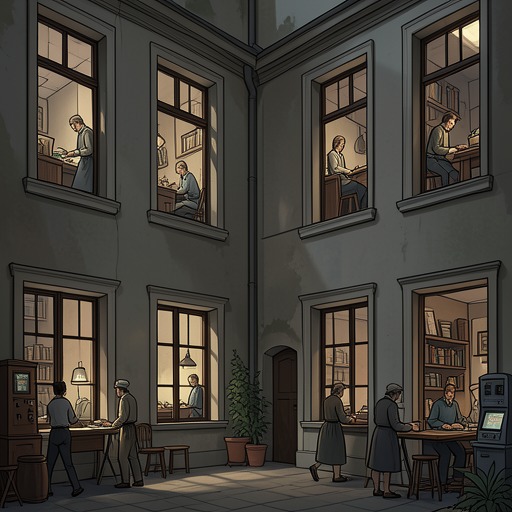
From this position, Jeffries can build a timetable of the rear-window dwellers’ habits without knowing their names or hearing their voices. Their faces are too small at that distance for identification. The visual field offers repeated actions more readily than personal knowledge: who leaves, which lights go out, and what a household does before night ends. In a neighboring home, a young couple repeatedly leave lights burning, then one partner rushes back to switch them off. Jeffries recognizes this recurring pattern as delayed action. In another, he watches a woman put her child to bed, prepare her face, and go out; on one occasion, he sees her sitting motionless with her head in her arms. These glimpses establish how readily a private life can become a sequence of visible gestures, while leaving much of its meaning beyond the watcher’s reach.
The architecture determines what can be seen. A house seen obliquely offers only narrow slits of windows, while the building at the end of the enclosed space presents its rooms more fully, like a dollhouse viewed from the side. Even there, windows, shades, distance, and interior partitions interrupt the image. Jeffries does not survey a complete world; he assembles partial scenes from separate openings. The apparent intimacy of the view depends on a physical separation that also limits what it can prove.
From Habit to Suspicion
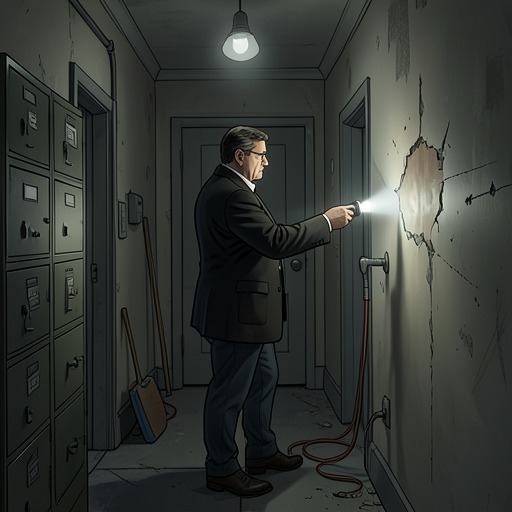
Jeffries’s attention shifts from casual observation to investigation when he notices Lars Thorwald’s departures from familiar behavior. His first clues are not direct evidence of a crime but breaks in routine: Thorwald’s wife does not come out to greet him, Thorwald does not go to her room, and he repeatedly looks around at the windows facing the enclosed space. Jeffries watches him make a slow, comprehensive sweep, beginning on the side opposite Jeffries and continuing toward his own window. To avoid attracting notice, Jeffries withdraws into the room until the look has passed.
The same outward sweep recurs, and its repetition begins to weigh differently from an ordinary glance. Jeffries notices the contrast between Thorwald’s apparent worry about his wife and his attention to the surrounding windows. At first, he even checks his suspicion against his own behavior: he, too, is watching other people. He distinguishes himself by thinking that he is merely idle, whereas Thorwald appears to have something to fear. That distinction does not resolve the uncertainty; it exposes how much Jeffries’s interpretation depends on reading intention from posture and movement.
The empty bedroom changes the force of earlier details. After Thorwald eventually enters it, raises the shade, looks around the room, and overturns two empty mattresses, Jeffries concludes that his wife is not there. The absence is visible, but it does not by itself establish what happened to her. Jeffries describes the arrival of certainty as Delayed action: details that had seemed inconclusive suddenly connect, and suspicion becomes a conviction that Thorwald has harmed his wife. He then lists the irregularities he has observed and tests them against the explanation that she is ill and has travelled. His reasoning is thus tied to looking, but also to the recognition that a missing figure and a pattern of behavior require interpretation rather than simply supplying a complete account.
The Gaze Reverses
The repeated scans acquire a sharper meaning once Jeffries uses the Spyglass. The lens brings Thorwald’s face into focus for the first time; Jeffries can also follow him farther into the apartment than his unaided sight allows. The instrument extends the range of observation, but does not make Jeffries omniscient. He still has to infer what Thorwald is doing from movements and fragments of rooms, and the increased visual reach also focuses his attention on the man whose notice he is trying to avoid.
A telephone call creates another line between the two windows. Jeffries reflects that he has accused Thorwald of murder for days but is only now hearing his voice for the first time. The connection briefly joins what the window had kept separate: a distant figure becomes a voice addressed to Jeffries. Later, when Jeffries tells Thorwald to look around, Thorwald puts down the receiver, moves to the living-room entrance, and makes a broad, encompassing look through the room. He returns to the telephone and calls Jeffries a liar. The episode does not give Jeffries control over what Thorwald sees or believes; instead, it lets the watched man respond on his own terms.
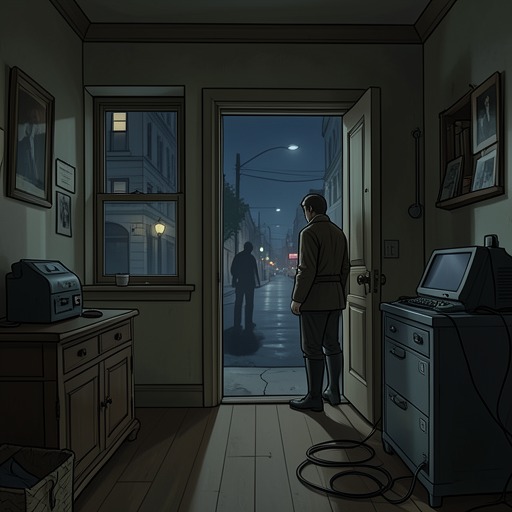
A later glance marks a more direct reversal. Thorwald briefly switches on a light, finds what he was looking for, and turns it off again. As he moves, his look lands squarely on Jeffries’s bay window. Unlike Thorwald’s earlier precautionary sweeps, this glance is brief and fixed on one place. Jeffries initially dismisses it as accidental. Only after the telephone line is cut does the sequence gather into a more alarming pattern: the silent call, the period of darkness, the targeted look, and the severed wire. The watcher’s earlier habit of treating separate movements as clues now works against his wish to discount the threat. In the story’s own recurring logic of delayed recognition, the meaning of the glance arrives after the glance itself.
The Limits of Looking
The return gaze changes the stakes of observation without making the scene fully mutual. Jeffries can see Thorwald across the courtyard, but Thorwald’s brief look does not reveal exactly what he knows. Jeffries must infer its purpose, just as he earlier inferred Thorwald’s motives from his scans. The story makes this uncertainty consequential: after the wire is cut, Jeffries concludes that the danger is inside his own house. Confined to his chair, he recognizes that shouting might bring neighbors to their windows but could not bring help in time. A gallery of people able to watch would not necessarily be able to intervene.
That contrast qualifies the apparent power of the view. Looking can make patterns legible: a missed greeting, a persistently lowered shade, an empty bed, or a gaze that breaks its usual sweep. Yet the same acts remain open to mistaken explanation until they accumulate, and even a well-founded interpretation does not guarantee protection. Jeffries’s observations help him suspect and confront Thorwald, but they also expose the limits of distance, sight, and assistance. Peeping and the Return Gaze therefore names not only the shift from watcher to watched, but the instability beneath that shift: each observer sees from a particular position, and neither visibility nor attention alone ensures knowledge or control.